About the Project
Acute pneumonia is a major public health
problem in Nepal and continues to cause
significant illness and death. Despite
improvements in healthcare, many challenges
remain such as limited resources, access
barriers, and rising antimicrobial resistance.
One key issue is that research priorities are
often decided without input from patients,
families, and communities. As a result,
research may not always address the real
problems people face.
This project aims to change that. Led by the
Nepal Intensive Care Research Foundation
(NICRF), this initiative brings together
patients, families, healthcare workers,
researchers, and policymakers to identify the
most important research questions about
pneumonia in Nepal.
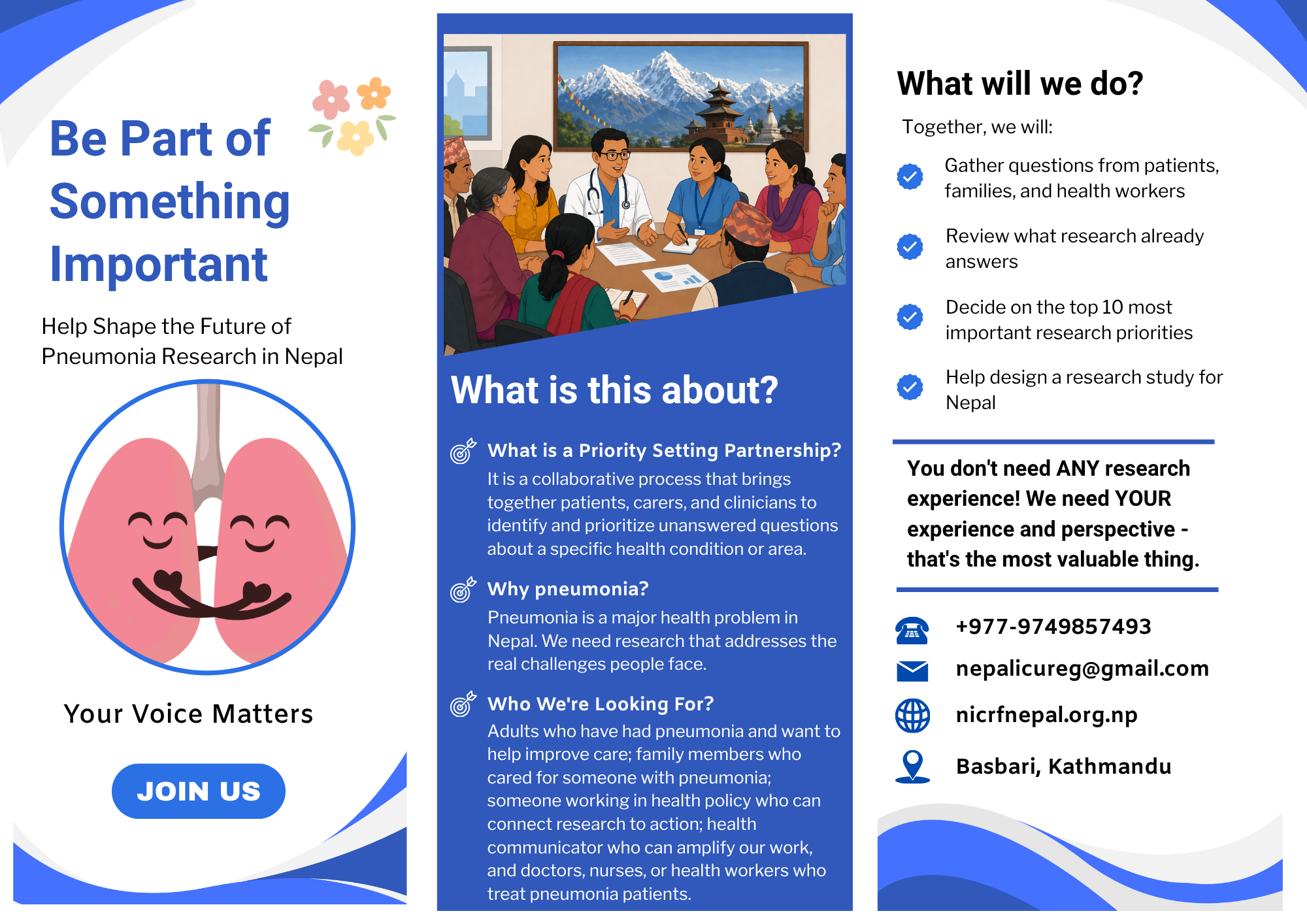
What is a Priority Setting Partnership (PSP)?
A Priority Setting Partnership (PSP) is a
collaborative process that brings together
patients, families, healthcare workers,
researchers, and policymakers to identify and
prioritize unanswered questions about a health
condition. It ensures that research focuses on
what matters most to people affected by the
condition—not just what researchers think is
important.
What Are We Trying to Answer?
What are the most important research questions
about pneumonia diagnosis, treatment, and care
in Nepal—from the perspective of patients,
families, and healthcare providers?
Our Objectives
-
To create a diverse partnership including
patients, families, the public, clinicians,
and researchers
-
To identify the most important research
questions related to pneumonia in Nepal
-
To support the development of a
Nepal-specific research study based on these
priorities
-
To contribute to ongoing global research
efforts such as REMAP-CAP
What Will We Do?
This project follows a step-by-step process:
-
Form an Advisory (Core) Group
A group of 15 members (patients, families,
and professionals) will be selected and
trained.
-
Collect Questions
We will ask people across Nepal:
"What questions about pneumonia care or
treatment should research answer?"
This will be done through surveys and
community events.
-
Review and Prioritize
Questions will be grouped and reviewed,
existing research will be checked, and the
most important questions will be
shortlisted.
-
Final Workshop
The group will meet to agree on the Top 10
research priorities.
-
Develop Research
The top priority question will be explored
for integration into an ongoing clinical
trial (REMAP-CAP).
Our Approach
We use the internationally recognized
James Lind Alliance (JLA)
method, adapted for Nepal. This approach
ensures:
- Equal voice for all participants
- Transparency in decision-making
- Focus on real-world needs
Who Can Get Involved?
We welcome:
-
Patients who have experienced pneumonia
- Family members and caregivers
- Doctors, nurses, and health workers
- Researchers and policymakers
- Members of the public
Project Timeline
-
Phase 1: Preparation &
Advisory Group formation
-
Phase 2: Question
collection (survey & events)
-
Phase 3: Prioritization and
final workshop
-
Phase 4: Integration into
research and dissemination
Impact
This project will:
-
Create a Top 10 list of pneumonia research
priorities for Nepal
-
Strengthen patient and public involvement in
research
-
Support development of relevant, practical,
and impactful research
-
Help improve patient care and health
outcomes
Ethics
This study has been submitted for ethical
approval to the Nepal Health Research Council
(NHRC).
Our Team
Sushila Paudel
Principal Investigator
Research Coordinator, NICRF
Dr. Diptesh Aryal
Co-Investigator
Executive Director, NICRF
Dr. Timo Tolppa
Co-Investigator
Critical Care Research Group, Ziauddin
University, Pakistan
Subekshya Luitel
Co-Investigator
Project Manager, NICRF
Janaki Pandey
Co-Investigator
Research Coordinator, NICRF
Narayani Ghimire
Co-Investigator
Research Coordinator, NICRF
Sambriddhi Thapaliya
Co-Investigator
Research Coordinator, NICRF